
Showing posts with label Climate Change. Show all posts
Showing posts with label Climate Change. Show all posts
Monday, 28 September 2009
Global Waming Hoax
Check out this website which proves 'EVIDENCE' which suggests GW is'nt totally the fault of humans!!

Have the Scientists got it right?
Global Warming predictions incorrect!
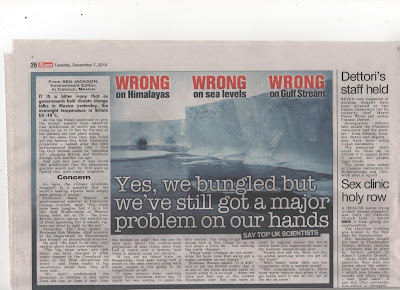
In the SUN Newspaper today, a report from the 2010 MEXICO summit in Cancun explains that scientists might have 'mis-led' some of us about the possible effects of Global Warming.
2 Flights a day by eco staff click on link to open up
In the SUN Newspaper today, a report from the 2010 MEXICO summit in Cancun explains that scientists might have 'mis-led' some of us about the possible effects of Global Warming.

Recently I blogged about world leaders trying to persuade us to 'all do our bit' to help reduce the effects of climate change. The Mirror newspaper even produced this headline from the 2009 Copenhagen Summit in Denmark:
75 Days to Save the World click on link to open up full story.
2 Flights a day by eco staff click on link to open up
Questions to think about:
1. Why does the worlds press give us such contradictory information ?
2. What are these climate summits all about? When do they take place?
3. Why has the MIRROR Newspaper company used such a powerful headline?
DUST STORMS and Climate Change

Dust storms like the one that plagued Sydney are blowing bacteria to all corners of the globe, with viruses that will attack the human body. Yet these scourges can also help mitigate climate change.
Read the full story here.
Tuesday, 8 September 2009
Climate Change: Effects
Time-Lapse Proof of Extreme Ice Melt
Photographer James Balog shares new image sequences from the Extreme Ice Survey, a network of time-lapse cameras recording glaciers receding at an alarming rate, some of the most vivid evidence yet of climate change. (see website link above). This is actual proof that the Northern Hemishpere's Ice Caps are melting!!
BBC News Footage of Ice Sheet Collapse in Antarctica
The Threat to Bangladesh (BBC News Mon Sept 7th 2009)
Repairing the sea walls in Bangladesh
Drought in Kenya: While rain batters some countries around the world, others face the alternative cosequence of climate change- DROUGHT. In Africa alone- over 220 million people must survive hotter and drier conditions.
The World Bank video below highlights the IMPACTS of climate change on communities around the world.
World Bank Competition Video Post
Photographer James Balog shares new image sequences from the Extreme Ice Survey, a network of time-lapse cameras recording glaciers receding at an alarming rate, some of the most vivid evidence yet of climate change. (see website link above). This is actual proof that the Northern Hemishpere's Ice Caps are melting!!
BBC News Footage of Ice Sheet Collapse in Antarctica
The Threat to Bangladesh (BBC News Mon Sept 7th 2009)
Repairing the sea walls in Bangladesh
Drought in Kenya: While rain batters some countries around the world, others face the alternative cosequence of climate change- DROUGHT. In Africa alone- over 220 million people must survive hotter and drier conditions.
The World Bank video below highlights the IMPACTS of climate change on communities around the world.
World Bank Competition Video Post
Climate Change: Future Implication
The Kyoto agreement has been set up to encourage countries to work together in order to reduce the impacts of climate change. BUT - what will happen to the world if we don't act?
FUTURE IMPLICATIONS for Earth
1. Postcards from the future- look at each postcard carefully and try to work out what has happened (you may need to watch the video twice).
2. The Age of Stupid - this newly relased movie looks at what might the planet might look like in the year if some of the fears associated with climate change actually materialise.
Postcards from the future?
FUTURE IMPLICATIONS for Earth
1. Postcards from the future- look at each postcard carefully and try to work out what has happened (you may need to watch the video twice).
2. The Age of Stupid - this newly relased movie looks at what might the planet might look like in the year if some of the fears associated with climate change actually materialise.
Postcards from the future?
Climate Change: Climate Models
or click on link above.
Before we can explore the causes and possible effects of climate change in different parts of the world, we need to understand how our worlds climate is influenced. For this, we need to understand the influence of the sun, winds, oceans and atmospheric gasses on the Earth- see below.
1. Solar Radiation The amount of heating the Earth’s surface receives depends on a number of factors. These include solar elevation (solar angle), cloud cover, length of day, and to a lesser extent, the length of path the Sun’s rays must take through the atmosphere. As the rays pass through the atmosphere, some of the radiation is absorbed, reflected or scattered. The Equator is warmer than the UK because the angle at which the Sun’s rays strike the surface is much higher, more direct illumination causes a more intense amount of heating. At the Poles it is colder than the UK because the angle that the Sun’s ray strikes the Earth is much lower and the intensity of heating is less.
2. Atmospheric Winds
High temperatures over the equator and low temperatures over the poles result in an imbalance of energy. However, heat energy at the Equator is transferred towards the Poles by global wind systems. As the Earth is rotating the circulation between the Equator and the Pole is split in three ‘cells’ in each hemisphere - the Hadley, Ferrel and Polar cells. These circulations of high and low pressure and the winds they generate affect the climate in different places.
3. Ocean Conveyor Belt System As climate is controlled partly by the transport of heat over the planet so ocean currents are important. The largest part of the heat transport system is known as the ‘the Global Heat Conveyer’. Differences in seawater density in different parts of the world cause flow from ‘high pressure’ (e.g. high density) to ‘low pressure’ (e.g. low density) regions, as in the atmosphere. These density changes are caused by changes in salinity (saltiness) and temperature. There is also a constant exchange of heat and water between the ocean and the atmosphere that affects climate.
4. The Greenhouse Effect Solar radiation passes through the atmosphere in the form of lightwaves - most of this radiation is absorbed by the earth heating it up
Some of the energy that has warmed the Earth is radiated back into space in the form of infrared waves
Some of this outgoing infrared radiation is trapped by the Earth’s atmosphere and warms it
Greenhouse gases remain in the atmosphere for long periods, and act as a ‘blanket’ around the earth absorbing the infra-red radiation from the earth and warming the earth’s surface. Without this natural greenhouse effect, the earth would be about 30°C colder. The burning of fossil fuels and deforestation has released large amounts of carbon dioxide and methane and other greenhouse gases. It is the increase in these gases which have led to warmer temperatures.
See Video Link here
Subscribe to:
Posts (Atom)